Ductless Mini-Splits vs. Central Air: Which Is Right for Your Washington, PA Home or Addition?
If you're planning a home addition, finishing a basement, converting a garage, or simply looking to replace an aging cooling system in Washington, Canonsburg, or elsewhere in Southwestern Pennsylvania, you've likely come across two very different paths: extending your existing central air system, or installing a ductless mini-split. At McVehil Plumbing, Heating & Air Conditioning, we've helped homeowners throughout this region make this exact decision since 1909, and the honest answer is that neither option is universally "better" — the right choice depends on your specific home, layout, and goals.
What Makes Ductless Mini-Splits Different
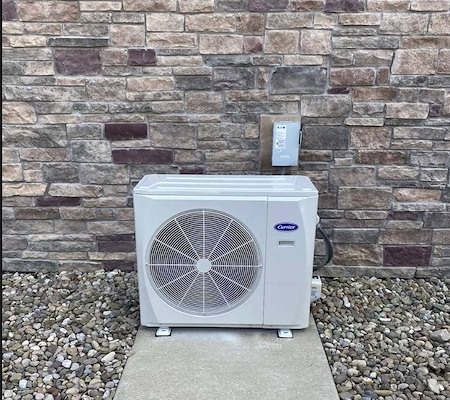
A ductless mini-split system pairs an outdoor compressor unit with one or more wall- or ceiling-mounted indoor air handlers, connected by a small refrigerant line that runs through a hole roughly 3 inches in diameter — no ductwork required. Each indoor unit heats and cools its own zone independently, which means you can keep a converted attic comfortable without running new ducts through a finished space, or heat a garage workshop without extending your whole-home system into an area it was never designed to reach.
Because there's no ductwork involved, mini-splits avoid the energy losses that come with leaky or poorly insulated duct runs — a common issue in older homes throughout Washington County. High-efficiency mini-split systems can reach up to 35 SEER2 for cooling and up to 30 HSPF2 for heating, well above what many older central systems achieve. That efficiency translates directly into lower monthly utility costs, especially in zones that aren't used constantly.
What Makes Central Air the Right Choice for Many Homes
For a whole-house system in a home with existing, well-sealed ductwork, central air still has real advantages. One thermostat controls the whole home, installation doesn't require visible indoor units mounted on walls or ceilings in every room, and if your ductwork is already in good shape, extending or replacing a central system is often more straightforward than installing multiple mini-split zones throughout an entire house.
Central air also tends to make more sense when you're replacing an existing system as a like-for-like swap, rather than adding cooling to a space that never had it. If your ducts are properly sized and sealed, a new high-efficiency central unit can deliver excellent performance without the aesthetic tradeoff of visible indoor units.
Key Factors to Weigh for Your Specific Situation
Central air also tends to make more sense when you're replacing an existing system as a like-for-like swap, rather than adding cooling to a space that never had it. If your ducts are properly sized and sealed, a new high-efficiency central unit can deliver excellent performance without the aesthetic tradeoff of visible indoor units.
Central air also tends to make more sense when you're replacing an existing system as a like-for-like swap, rather than adding cooling to a space that never had it. If your ducts are properly sized and sealed, a new high-efficiency central unit can deliver excellent performance without the aesthetic tradeoff of visible indoor units.
Central air also tends to make more sense when you're replacing an existing system as a like-for-like swap, rather than adding cooling to a space that never had it. If your ducts are properly sized and sealed, a new high-efficiency central unit can deliver excellent performance without the aesthetic tradeoff of visible indoor units.
How do you feel about indoor units? Mini-split air handlers are mounted visibly on walls or ceilings in each conditioned room. Some homeowners don't mind this at all; others prefer the completely hidden delivery of ducted central air. This is a legitimate factor, not just an aesthetic afterthought.
Why a Professional Assessment Matters
Cost guides and pros-and-cons lists are useful starting points, but the right answer for your home depends on your specific layout, existing ductwork condition, insulation, and how you plan to use the space. A homeowner adding a single home office might do best with one mini-split zone; a homeowner finishing an entire second-floor addition might find that extending central air, or installing multiple mini-split zones, makes more sense depending on the ductwork access available.
We always recommend a walk-through with a technician who can evaluate your existing system, your addition or renovation plans, and your budget before recommending a direction — rather than assuming one option fits every situation.
Get an Honest Recommendation for Your Home
Whether you're finishing a basement, adding a sunroom, or simply ready to replace an aging cooling system, the McVehil team can walk you through both options honestly, with no pressure toward whichever system happens to be easier for us to install.
Contact McVehil Plumbing, Heating & Air Conditioning today to schedule a consultation for your home or addition. Our team proudly serves Washington, Canonsburg, McMurray, Bethel Park, and Waynesburg, PA, as well as Wheeling and Morgantown, WV — with up-front pricing and 24/7 service when you need us most. Call 724-225-3500 or request a quote online and experience the McVehil Difference.

Request a Quote and Experience the McVehil Difference! Contact Our Local Plumbers and Heating and Cooling Experts Today!